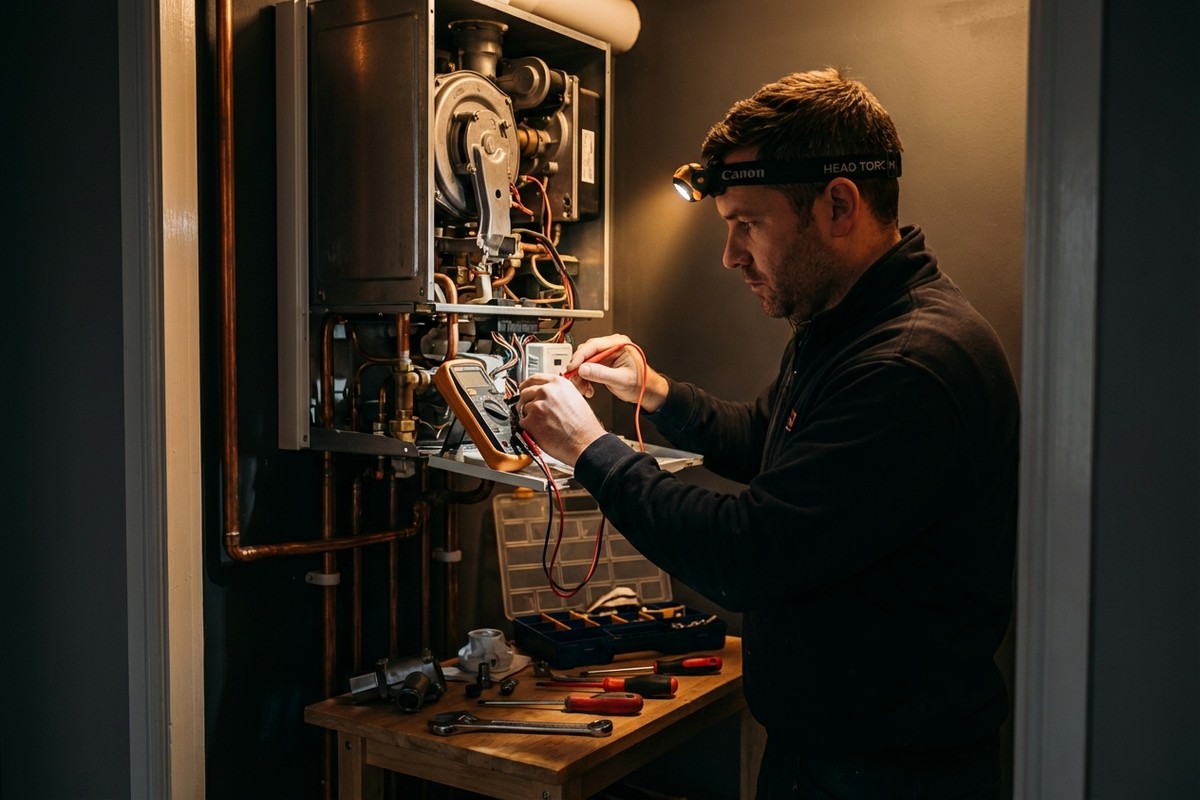
A broken boiler is never convenient. Whether you have woken up to no hot water, come home to a cold house, or noticed your boiler flashing an error code you have never seen before, you need an engineer who can diagnose the problem and fix it quickly. Ability Plumbing & Heating provides fast, reliable boiler repair across Sevenoaks, Tonbridge, Tunbridge Wells, Maidstone, Orpington, and Edenbridge. Our Gas Safe registered engineers work on all major boiler brands and carry common replacement parts so many repairs can be completed on the first visit.
Boiler not working? Call 01732 904098 for same-day availability.
Common Boiler Problems We Fix
Over 15 years of repairing boilers across Kent, we have seen every fault there is. Here are the most common boiler problems homeowners call us about:
- No heating or hot water -- Often caused by a faulty diverter valve, motorised valve, thermostat, or low system pressure.
- Boiler losing pressure -- Usually caused by a leak in the system, a faulty pressure relief valve, or a problem with the expansion vessel.
- Boiler leaking water -- Leaks can come from internal seals, the heat exchanger, or pipe connections. Any visible leak should be checked promptly.
- Kettling noises -- A rumbling or banging sound from the boiler, typically caused by limescale or sludge buildup on the heat exchanger.
- Boiler locking out or displaying error codes -- Modern boilers lock out as a safety measure when they detect a fault. The error code tells us where to look.
- Frozen condensate pipe -- Common during cold snaps. The condensate pipe runs outside and can freeze, causing the boiler to shut down.
- Pilot light going out -- On older boilers with a permanent pilot, this can indicate a faulty thermocouple or gas valve issue.
- Radiator cold spots -- Often a sign of sludge in the system rather than a boiler fault, but the boiler may need attention if it is working harder to compensate.
Common Boiler Error Codes
If your boiler is displaying an error code, here are some of the most common ones we see:
Vaillant
F22 (low water pressure), F28 (ignition failure), F75 (pressure sensor fault)
Worcester Bosch
EA (ignition failure), D1 (safety temperature limiter), A281 (fan speed fault)
Ideal
L2 (ignition lockout), F1 (low water pressure), FD (flame detection fault)
Baxi
E119 (low water pressure), E133 (ignition lockout), E168 (no signal from flame sensor)
Our Repair Process
When you call us with a boiler problem, here is what happens:
- 1You describe the symptoms -- Tell us what the boiler is (or is not) doing, any error codes displayed, and the make and model if you know it.
- 2We book an appointment -- Same-day appointments are available for urgent breakdowns. For non-urgent repairs, we will arrange a time that suits you.
- 3Our engineer diagnoses the fault -- On arrival, our Gas Safe registered engineer carries out a systematic diagnosis to identify the root cause. We explain the problem in plain English before doing any work.
- 4You receive a written quote -- We provide a clear price for the repair before starting. No surprises. If the repair is not economical, we will tell you honestly and discuss your options.
- 5We carry out the repair -- Many repairs can be completed on the first visit. If specialist parts are needed, we order them and return to finish the job as quickly as possible.
Should I Repair or Replace My Boiler?
This is one of the most common questions we are asked. Here is a straightforward guide:
- Age: If your boiler is under 10 years old, repair is almost always the right choice. Between 10 and 15 years, it depends on the cost of the repair and the boiler's overall condition. Over 15 years, replacement becomes increasingly sensible.
- The 50% rule: If the repair cost exceeds 50% of the price of a new boiler, replacement is usually the better investment.
- Efficiency: Modern A-rated boilers operate at 90% efficiency or higher. Older boilers may only achieve 60-80%. The energy savings from a new boiler can offset the cost over 5-8 years.
- Warranty: If your boiler is still under warranty and has been annually serviced, the repair may be covered at no cost to you.
- Frequency: If you have had multiple repairs in the last 12-18 months, the boiler is telling you something. Continued patching often costs more than replacement in the long run.
Emergency Boiler Information
What Constitutes a Boiler Emergency?
- Smell of gas: Turn off the gas supply at the meter, open windows, and call the National Gas Emergency Service immediately on 0800 111 999. Do not operate any electrical switches.
- Carbon monoxide alarm sounding: Leave the property immediately with all occupants, call 999, and then call the Gas Emergency Service on 0800 111 999. Do not re-enter until cleared by a professional.
- Significant water leak from the boiler: Turn off the water supply and the boiler, and call us.
- No heating or hot water in freezing conditions (particularly if vulnerable people, elderly residents, or young children are in the property): Contact us for priority attention.
What You Can Safely Do While Waiting
- Re-pressurise the boiler: If the pressure gauge reads below 1 bar, you can usually top it up via the filling loop. Your boiler manual will show you how.
- Reset the boiler: Press the reset button once. If the boiler locks out again, do not keep resetting it -- call an engineer.
- Check the thermostat: Make sure it is set to the correct temperature and the timer is active. Sometimes the simplest explanation is the right one.
- Thaw a frozen condensate pipe: Pour warm (not boiling) water over the external condensate pipe to melt any ice blockage. This is a common winter fix.
Boiler Repair Cost
Boiler repair costs vary depending on the fault. Here are typical price ranges:
- Minor repairs (thermostat replacement, pressure valve, reset issues): £100-£200
- Mid-range repairs (diverter valve, pump replacement, fan motor): £200-£400
- Major repairs (heat exchanger, PCB replacement): £300-£500+